Verdant Data Center Whitepaper
Verdant Data: ia a brand for a subset of our Community Management as a Service.
AI, Energy, Data Centers, and Community Working in Harmony
Regenerative Digital Public Infrastructure Framework
Broadband Institute Foundation, dba Community Internet
A 501(c)(3) Educational Nonprofit

Do you value sustainability?
Make Values Valuable Again
When others ask about your hat, ask them to describe their top value and the help they would like to make it valuable.
Our Platform Cooperative:
- Voluntary and Open Membership
- Democratic Member Control
- Member Economic Participation
- Autonomy & Independence
- Education, Training, and Information
- Cooperation among Cooperatives
- Concern for Community
Executive Summary
The Broadband Institute Foundation, doing business as Community Internet, is a 501(c)(3) educational nonprofit dedicated to advancing digital equity through sustainable, community-owned infrastructure. As a non-partisan organization, we operate outside the traditional boundaries of “Red” and “Blue.” Instead, we embrace a solutions-oriented, community-first philosophy grounded in listening, transparency, and empowerment.
This paper outlines a new paradigm where energy, data, and community governance operate in harmony to create a regenerative digital ecosystem. Through distributed renewable energy, local micro-data hubs, and cooperative broadband models, communities can reclaim control of their digital future—ensuring affordability, resilience, and shared prosperity.
Our approach advances participatory democracy by enabling frictionless bottom-up decision-making, giving communities the agency to shape their own digital infrastructure. Technology becomes a tool for empowerment, not extraction.
I. Introduction
Across the United States, there is a growing recognition that the digital divide is not merely a technical problem—it is a structural one. Many communities, especially rural areas, tribal nations, and urban neighborhoods historically excluded from investment, continue to pay more for slower and less reliable internet services. Meanwhile, corporate data centers and telecom monopolies concentrate wealth far from the communities they serve.
Community Internet seeks to change this equation by designing digital systems that are local, renewable, and community-owned.
As a non-partisan 501(c)(3) organization, our mission is not ideological. It is fundamentally practical: to equip communities with tools, knowledge, and governance models that enable them to build, operate, and benefit from their own digital infrastructure.
We believe that real solutions begin by listening—deeply and continuously—to the lived experience of community members. Our platform and programs are designed to support collaborative, transparent decision-making that reflects local priorities and values.
II. A Regenerative Approach: Energy + Data + Community
A regenerative digital ecosystem brings three elements into harmony:
1. Clean, Local Energy
Traditional data centers store our digital lives using vast amounts of grid electricity—often derived from fossil fuels—with communities bearing the environmental cost but receiving little benefit.
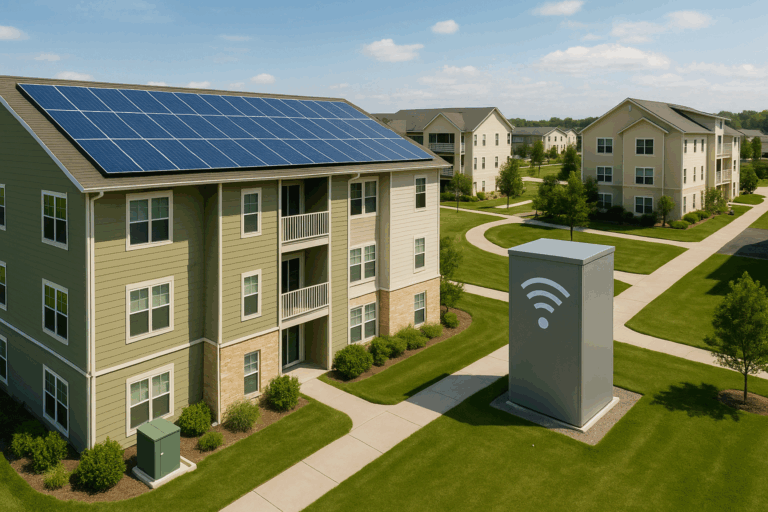
Community Internet promotes an alternative: small-scale solar-powered micro data hubs housed in neighborhoods, schools, libraries, and affordable housing developments. These hubs reduce emissions, cut costs, and keep energy revenue circulating locally.
2. Community-Owned Data Infrastructure
Data is the new infrastructure of daily life—touching education, healthcare, workforce development, small business growth, and civic participation. But today, most data services are centralized, expensive, and designed to extract value from local communities.
By contrast, our model supports:
- cooperative broadband networks
- community-controlled cloud services
- local content caching
- distributed compute optimized for local needs
- reduced reliance on remote corporate platforms
Ownership leads to resilience, affordability, and autonomy.
3. Participatory Community Governance
This is where harmony becomes possible.
Our tools and methods support participatory democracy, enabling communities to make decisions collectively, quickly, and with minimal friction.
We provide:
- accessible online forums
- voting and consensus tools
- project co-design sessions
- transparency dashboards
- community governance playbooks
This approach ensures infrastructure aligns with local priorities, not external agendas.
III. Why Non-Partisan Solutions Matter
Digital equity and technological empowerment are not partisan issues—they are community well-being issues.
Whether a community leans conservative or progressive, rural or urban, coastal or inland, one truth is universal:
People deserve reliable, affordable, locally accountable digital services.
And whether leaders identify as:
- elected officials
- library directors
- tribal councils
- housing developers
- unions
- business associations
- nonprofit organizations
their goals converge around:
- better access
- lower costs
- stronger communities
- durable local economies
By positioning ourselves outside the Red/Blue divide, we help bridge conversations that politics often fragments.
IV. How Community Internet Works
Step 1: Community Listening
We begin with deep listening sessions, interviews, and collaborative design workshops. These ensure that solutions emerge organically rather than being imposed.
Step 2: Educational Support & Technical Planning
As a 501(c)(3), our role is to help communities understand their options—technical, financial, regulatory, and organizational.
Step 3: Local Ownership Structures
We help communities evaluate models such as:
- digital cooperatives
- nonprofit broadband authorities
- public–private partnerships
- neighborhood-managed micro data hubs
Step 4: Renewable-Powered Digital Infrastructure
We design architectures that combine:
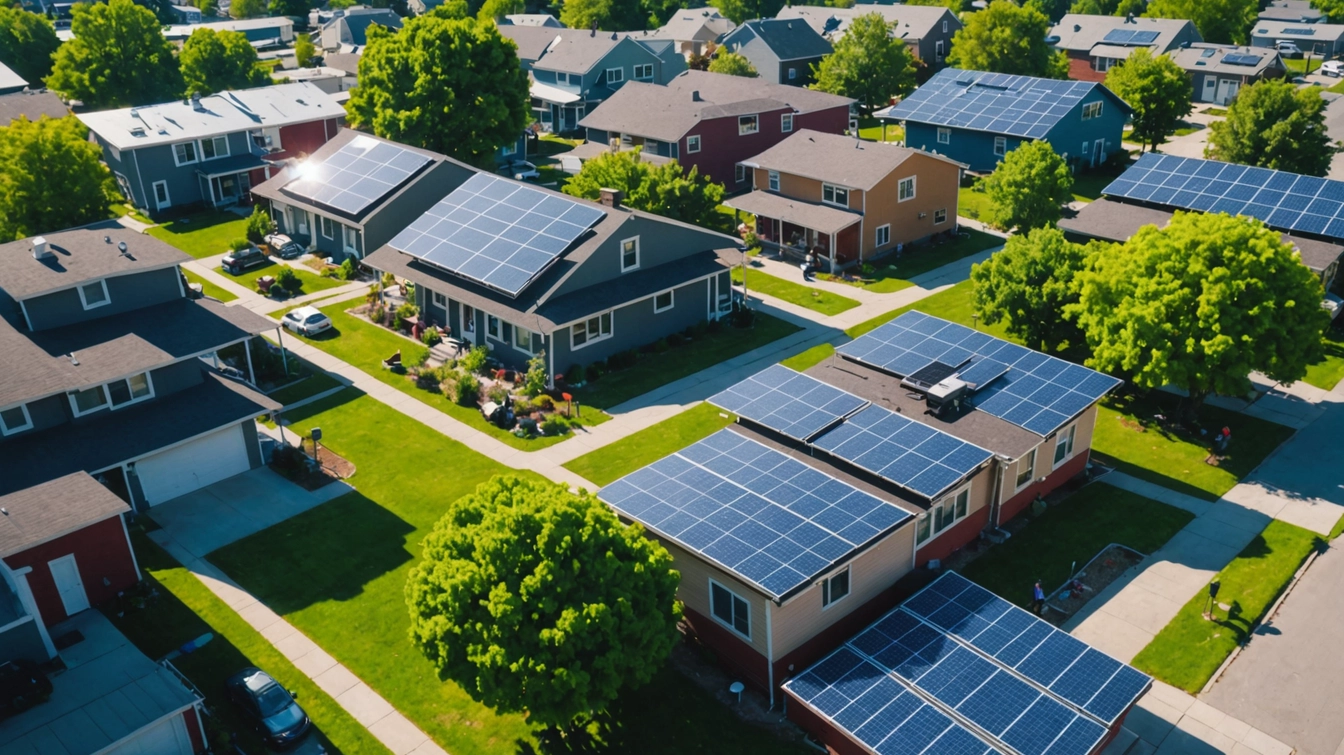
- rooftop or community solar
- battery storage
- micro-data hubs
- mesh Wi-Fi
- local compute and caching
Step 5: Participatory Governance
Communities manage their networks through transparent, bottom-up decision-making tools.
V. Impacts of a Regenerative Digital Ecosystem
Economic Benefits
- Keeps digital revenue local
- Reduces dependence on large telecom monopolies
- Creates local jobs in installation, operations, and management
Educational Benefits
- Libraries become digital learning hubs
- Students gain reliable access for remote learning
- Community organizations gain cloud resources for training
Social & Civic Benefits
- Greater digital inclusion
- Increased civic participation through modern tools
- Strengthened community trust and cohesion
Environmental Benefits
- Reduced carbon footprint
- Less energy waste through localized compute
- Integration with community solar initiatives
VI. Real-World Alignment: A Modern TVA for the Digital Era
The Rural Electrification Act and the Tennessee Valley Authority transformed communities by empowering them to build what private industry would not. Today, the digital future demands a similarly bold, community-centered approach.
Just as rural cooperatives built their own electricity networks, communities today can build their own clean-powered broadband and data systems—with the support and guidance of organizations like the Broadband Institute Foundation.
VII. Conclusion
Harmony between energy, data, and community is not an abstraction—it is a design choice.
By grounding digital infrastructure in renewable energy, local ownership, and participatory governance, we unlock a regenerative economic model where communities do not simply consume digital services—they shape, own, and benefit from them.
Community Internet is proud to support communities across the country as they reclaim their digital future, build durable local economies, and create a more equitable, sustainable, and connected world.
Footnotes
American Library Association. (2021). Libraries as community technology hubs: A national analysis. ALA Office for Information Technology Policy. https://www.ala.org
Benkler, Y. (2006). The wealth of networks: How social production transforms markets and freedom. Yale University Press.
Federal Communications Commission. (2022). Broadband deployment report. U.S. Government Printing Office. https://www.fcc.gov
Hanna, T. M., & Mitchell, C. (2022). Publicly owned broadband: The future of equitable digital access. Economic Policy Institute. https://www.epi.org
Institute for Local Self-Reliance. (2020). Community networks: The role of local broadband in economic development. ILSR Publications. https://ilsr.org
Knight Foundation. (2021). Civic engagement in the digital era: Tools for participatory democracy. Knight Commission on Trust, Media, and Democracy. https://knightfoundation.org
National Renewable Energy Laboratory. (2021). Distributed energy resources and local resilience: Technical and economic modeling. U.S. Department of Energy. https://www.nrel.gov
Ostrom, E. (1990). Governing the commons: The evolution of institutions for collective action. Cambridge University Press.
Solar Energy Industries Association. (2023). Community solar and local energy resilience: Market trends and policy considerations. SEIA Research. https://www.seia.org
U.S. Department of Agriculture. (2016). Rural Electrification Act of 1936: Historical overview and policy impact. USDA Rural Development. https://www.rd.usda.gov